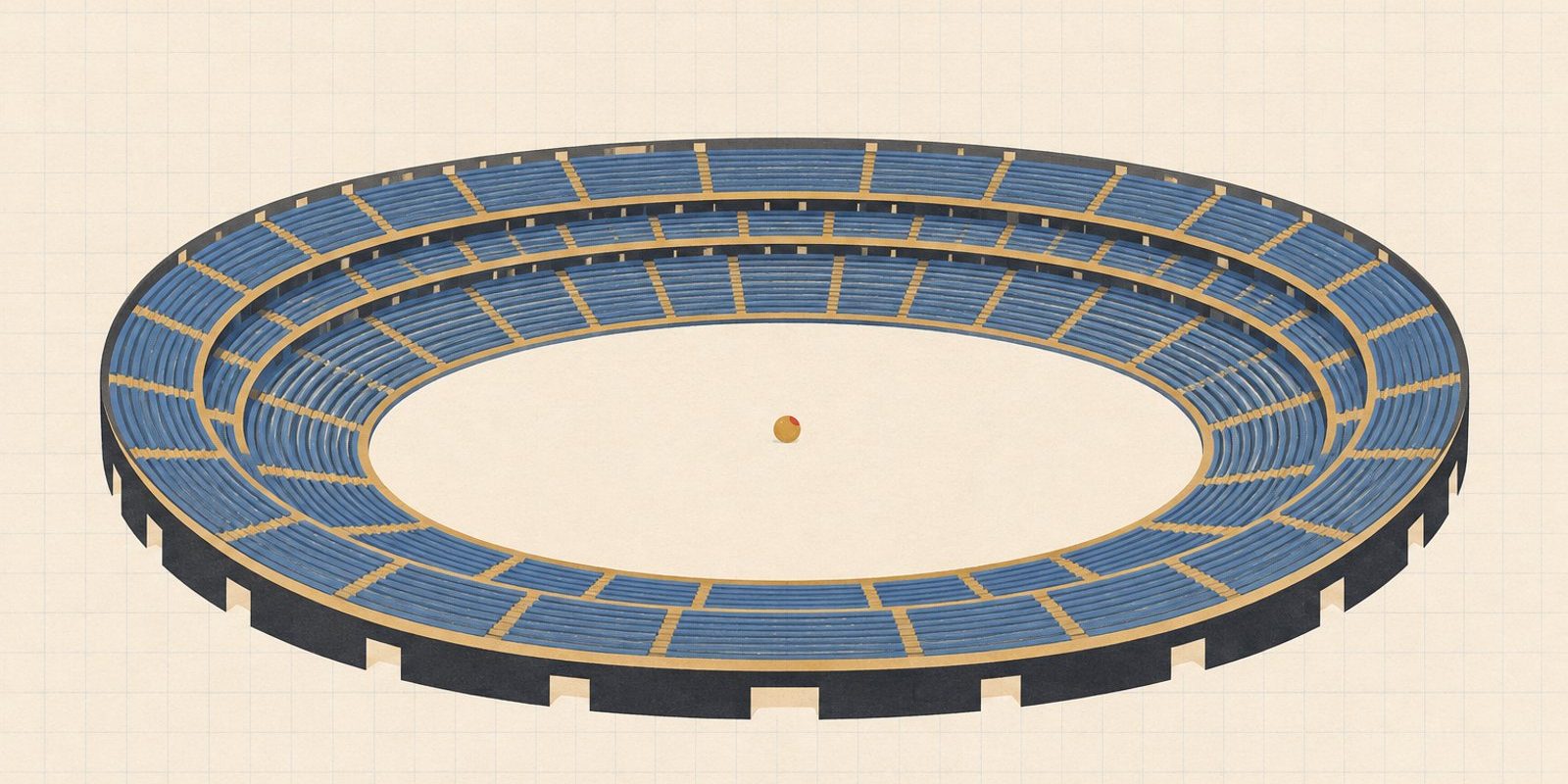
Picture Michigan Stadium on a fall Saturday. Every seat is taken: 107,601 people (University of Michigan, 2015). Somebody in that crowd is holding the one winning Powerball ticket. Which one? You can’t tell, and neither can anyone else.
Now picture a second stadium just like it. And a third. Keep going. To match the number of possible Powerball tickets, you need about 2,716 full stadiums. Your ticket is one face among all of them.
What 1 in 292 million looks like
The official Powerball jackpot odds are 1 in 292,201,338 per ticket (Powerball.com, 2026). That figure has been in place since October 2015, when the game moved to 69 white balls and 26 red ones (Associated Press, 2015).
Divide that number by the Michigan Stadium crowd and you get roughly 2,716 sellouts. That is the largest stadium in the country, filled nearly 2,700 times, with exactly one lucky seat.
Or think of cost. Each ticket is $2, so covering every possible combination would take about $584 million in tickets (292,201,338 x $2).
Twice a week, for a lifetime
Say you buy one ticket for every drawing, twice a week, for 80 years. That is 104 tickets a year, or 8,320 tickets. Your chance of ever holding the jackpot is about 8,320 in 292 million. That works out to roughly 1 in 35,000.
To expect even one jackpot at that pace, you would need about 2.8 million years of twice-weekly play. That is 292,201,338 divided by 104 tickets a year.
Now flip it around. Your 8,320 lifetime tickets are about 0.003 percent of all possible tickets. In stadium terms, that is 8,320 seats, less than a tenth of one stadium, out of 2,716 packed bowls. Yet a hand of seats feels like “a real shot” when the jackpot is on the news. That gap between feeling and arithmetic is the whole story.
Even one ticket per week, 52 per year, only moves the needle from “essentially zero” to “essentially zero, with more receipts.”
What a $2 ticket is “worth”
Expected value is the average result if you could replay a bet endlessly. Take the eight fixed lower prizes, from $4 up to $1 million, with their published odds (Powerball.com, 2026). Weight each prize by its chance and add them up. You get about 32 cents per $2 ticket. That is a calculation for this article, not a figure the lottery publishes, and it leaves out Power Play and the jackpot.
| Match | Prize | Odds |
|---|---|---|
| Powerball only | $4 | 1 in 38.32 |
| 4 white balls | $100 | 1 in 36,525 |
| 5 white balls | $1,000,000 | 1 in 11,688,054 |
| Jackpot | Grand prize | 1 in 292,201,338 |
The jackpot adds more, but how much depends on its size on the day, on taxes, on the cash-versus-annuity choice and on how many winners split it. It is the part that is hardest to picture, and the part that moves.
Where the money goes
Lottery rules set how much of each dollar becomes prizes. In Oregon, for example, the Powerball prize pool is 50 percent of each drawing’s sales (Oregon Administrative Rules, 177-085-0025). On average, about 35 percent of every $2 ticket stays in the state where it was sold, to fund public programs (Powerball.com, 2026). Rules differ by state, so treat 50 percent as one example, not a national audit.
One ticket is one face in 2,716 full stadiums.
The catch in “somebody always wins”
Here is the twist. Winning is very rare for you and still routine for the game. Millions of tickets are sold, so a winner turns up every so often. Both facts are true at once. A jackpot being won says nothing about how likely your own ticket is.
The odds of winning any prize at all are about 1 in 24.87 (Powerball.com, 2026). Most of those wins are $4 or $7. The same game that makes small wins common makes the big one a statistical ghost.
It also helps to remember what a ticket really buys: a few minutes of hoping. That can be a fair price for entertainment. The danger is mistaking the hope for a plan. A budget for fun is a spending choice. A plan to get rich is a bet against a stadium of strangers.
The takeaway: 1 in 292 million is not “unlikely.” It is a stadium of strangers, 2,716 times over.
For illustration only. Not financial advice.
Sources
- Multi-State Lottery Association, “Powerball Prize Chart”, Powerball.com, 2026. link
- Multi-State Lottery Association, “Powerball FAQs”, Powerball.com, 2026. link
- Oregon Secretary of State, “OAR 177-085-0025 (Powerball prize pool)”. link
- University of Michigan Athletics, “U-M announces new seating capacity for Michigan Stadium”, 2015. link
- Associated Press via NBC10 Philadelphia, “New Powerball Changes Increase the Odds”, 2015. link