You glance at your wrist at 9 p.m. The ring is almost closed. You are 1,800 steps short, so you pace the kitchen like a caged tiger. Why? Because a number told you to.
That number is 10,000. It feels like a law of nature. We went looking for where it came from, and the trail starts in Japan, with a gadget and a name.
The claim
The claim: you need 10,000 steps a day to be healthy. Most fitness trackers set it as the default goal. Many people treat 9,999 as a small failure.
The trail leads to Tokyo
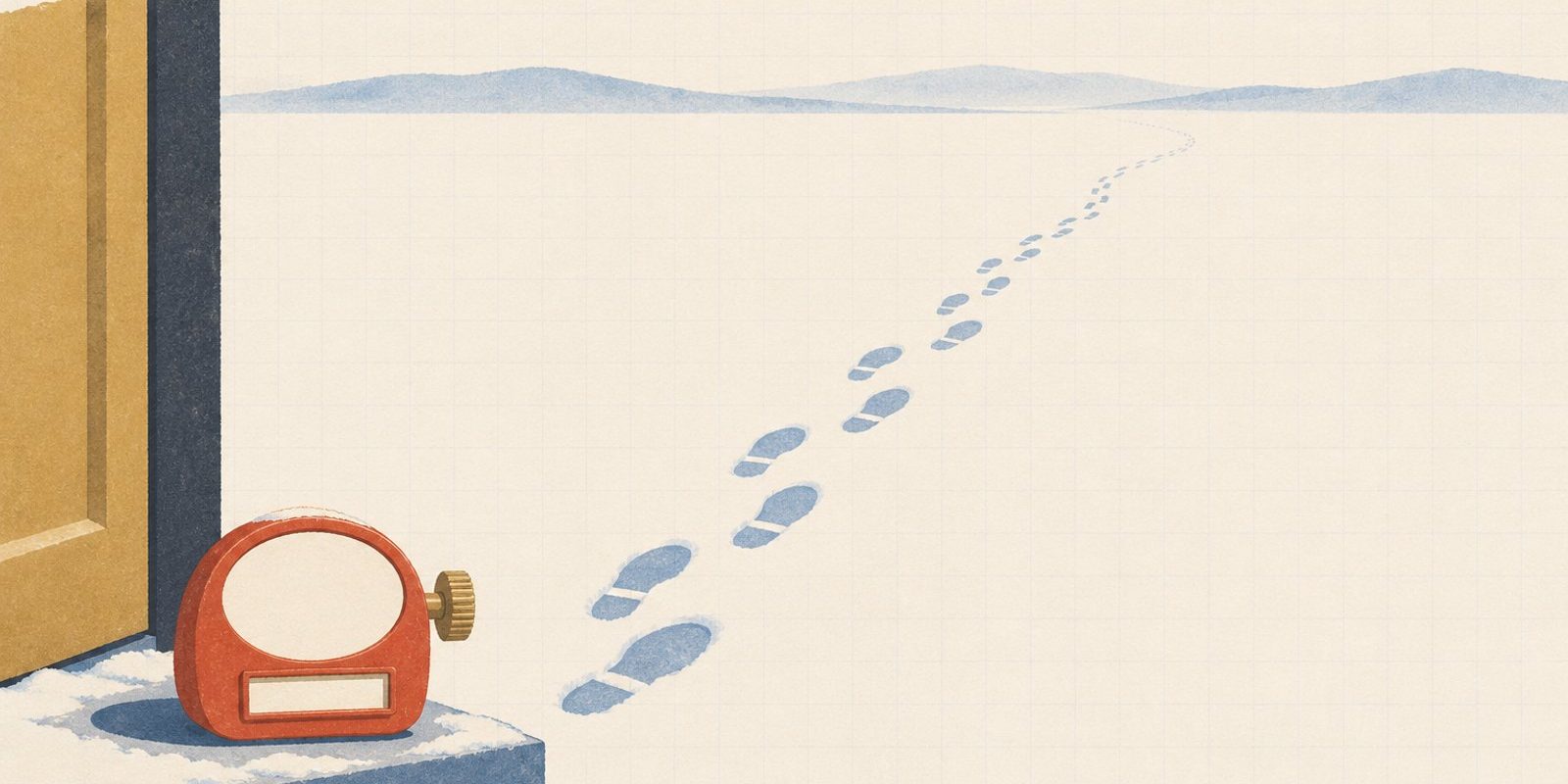
In 1965, the year after the Tokyo Olympics, a Japanese company released a step counter called the Manpo-kei. That translates roughly to “10,000-step meter” (Harvard Health, 2019). Other outlets name the maker as Yamasa, a clock and instrument company.
So the number was in the product name. Sources disagree on who designed the device and how much research sat behind it. A Japanese researcher named Yoshiro Hatano did study step counts, but accounts place that work later, and his exact role is only partly supported. What the sources agree on is the point that matters here: Harvard epidemiologist I-Min Lee has said no studies had looked at “10,000 steps” when the gadget appeared (Popular Science, 2019).
Round numbers sell. Ten thousand sounds big, but doable. It is easy to remember. That is a marketing virtue, not a medical one.
What the science actually found
Researchers later tested the number. In 2019, I-Min Lee and colleagues tracked 16,741 older US women, average age 72, who wore step trackers for a week. Over about 4.3 years, 504 of them died. Women who averaged around 4,400 steps a day had a death rate about 41% lower than the least active quarter, who averaged around 2,700. The benefit leveled off near 7,500 steps (Lee et al., JAMA Internal Medicine, 2019).
In 2022, Amanda Paluch and a large team pooled 15 studies covering 47,471 adults. Among adults 60 and older, risk fell as steps rose until roughly 6,000 to 8,000 a day. Among adults under 60, the curve flattened around 8,000 to 10,000 (Paluch et al., Lancet Public Health, 2022).
A goal of 10 000 steps/d is commonly believed by the public to be necessary for health, but this number has limited scientific basis.
Lee et al., JAMA Internal Medicine, 2019
| Study | Who | Where the benefit leveled off |
|---|---|---|
| Lee et al., 2019 | 16,741 women, average age 72 | About 7,500 steps a day |
| Paluch et al., 2022 | Adults 60 and older | About 6,000 to 8,000 steps a day |
| Paluch et al., 2022 | Adults younger than 60 | About 8,000 to 10,000 steps a day |
The twist: 10,000 is not crazy
Here is the part that complicates the debunk. The younger-adult range in the 2022 study runs up to 10,000. So the marketing number landed inside a range that real data later supported for some people. It was a lucky guess, not a finding.
There are other limits. Both studies are observational. They show that people who walk more tend to live longer, not that walking caused it. Fit, healthy people walk more, and sick people walk less. The studies adjusted for many factors, but that cannot be fully removed. The 2019 study only looked at older women. And both measured death, not mood, sleep or how you feel.
Also, total steps mattered more than speed. After accounting for steps, the link with faster stepping mostly faded in the 2019 study.
The verdict: TRUE BUT MISLEADING
Is 10,000 the magic number? No. It began as a product name, not a research result. Does walking more go with living longer? Yes, in these studies, with the gains shrinking as the count climbs. This article is about where the number came from, not a personal recommendation.
How to spot it next time
- Ask who first said it, and when. A round number with no named study behind it deserves a second look.
- Check the study group. Women over 70 are not the same as college students.
- Look for the word “associated.” It is not “caused.”
- Notice where the curve flattens. “More is better” often means “more is better, up to a point.”
The number on your wrist started as a name on a box. The steps themselves are real.
Sources
- I-Min Lee et al., “Association of Step Volume and Intensity With All-Cause Mortality in Older Women”, JAMA Internal Medicine, 2019. link
- Amanda E. Paluch et al., “Daily steps and all-cause mortality: a meta-analysis of 15 international cohorts”, Lancet Public Health, 2022. link
- Harvard Health Publishing, “10,000 steps a day — or fewer?”, 2019. link
- Popular Science, “No, you don’t need 10,000 steps a day”, 2019. link